
Where does the legend of the Christmas Elves come from?
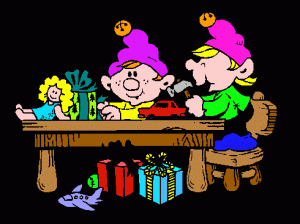
Although a pagan belief refers to mischievous little beings who joined the people to celebrate Saturnalia, it was not until a text by Clement Clark Moore entitled "A Visit from St. Nicholas," published in 1823 in the New York newspaper "Sentinel," that we became acquainted with these little creatures who assisted Saint Nicholas in distributing gifts to children. Since then, the story has been spread throughout the world and translated into several languages.
In Denmark
Before the 19the siècle, on retrouve dans les légendes danoises entourant Christmas, un elf minuscule appelé Julenisse who accompanied Odin. He helped with the farm work and, on Christmas Eve, the children left him a note asking for gifts.
In Norway
A character very similar to the one in Denmark is called Julenissen in Norway. He is described as wearing a sweater with rustic patterns, a homespun jacket trimmed with fur, a red cap and sporting a white goatee. We will have to wait until the second part of the 19the century so that this friendly character is compared to that of Saint Nicholas, to whom he comes to lend a hand on Christmas Eve.
Elves of all legends
These little creatures are part of the legends of several European countries, particularly throughout Scandinavia. From generation to generation, it was said that on Christmas Day, they come out of their homes (underground or in the forests) to celebrate Christmas Eve in the villages while the inhabitants are asleep. Depending on the country, elves were once considered mischievous or even mean or, on the contrary, friendly, especially with children. Today, almost everywhere, when we refer to Christmas elves, we think more of their role as Santa's helpers in making toys and wrapping gifts.
I have the pleasure of doing some research on Christmas elves tonight with my beautiful Elizabeth.