
So who was Father Fouettard?
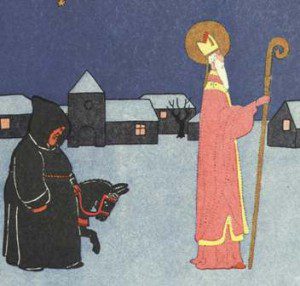
Tout comme le Père Christmas, le Père Fouettard est un personnage associé à cette belle période de la fin d’année. À l’instar des autres légendes, son origine est cependant très controversée. En effet, il existe un bon nombre de versions de ce personnage rude qui accompagnait Saint-Nicolas pour distribuer des punitions aux enfants qui n’avaient vraiment pas été sages.
In history, he is traditionally depicted as a sinister-looking figure dressed entirely in black, wearing long boots and a large cloak. Depending on the version, he sometimes wears a hood or a cowl and holds a wooden stick or a short whip. In Belgium, however, Père Fouettard has black skin like that of Africans, wears brightly colored clothing, and wears earrings.
The Butcher's Dark History
Cette légende tirerait son origine d’un conte qui se termine bien mais reste, somme toute, assez effrayant. Il raconte que trois petits enfants qui s’étaient perdus demandèrent asile à un boucher. Comme celui-ci était méchant, il les tua et rangea les corps dans son saloir. Plus tard, Saint Nicholas vient à passer et il devina ce que le boucher avait fait. Ce dernier s’enfuit et Saint Nicolas ressuscita les trois enfants.
Oral tradition has changed the story over time: Saint Nicholas is said to have forced the butcher to follow him all Christmas night, during his distribution of gifts, and he is said to have assigned him the task of threatening with a whip the children who had been disobedient during the year.
The one in Metz
Another version claims that the legend of Père Fouettard originated in Metz in 1552, during the siege of the city by Charles V's army. During a procession in the city, the inhabitants paraded through the streets with a mannequin bearing the image of the emperor before burning it. Some then amused themselves by chasing young people with the blackened mannequin, in whose hand a whip was tied.
During the same period, as belief in Saint Nicholas was growing, the black mannequin was resurrected under the name of Père Fouettard, who accompanied the holy man on Christmas Eve for the distribution of gifts.
Other names for Father Fouettard
In Bavaria and Austria it is called Krampus, which means hook, while in some other regions of Germany it is nicknamed Ruprecht or Knechtruprecht. Whatever his name, his mission is the same: to correct difficult children. But whatever his name, his mission is always to correct disobedient children. A character inspired by Father Fouettard is also found in the Rhineland, Silesia and a few other places, in the form of an animal, most often a goat, whose name is Pelzbock, Rasselbock, Pelznickel, Pelzruppert or even Bartel. The most impressive performance of Père Fouettard takes place every year in the Netherlands, where the feast of Saint Nicholas is celebrated with great pomp.

Father Fouettard is here to avenge me, Antoine. You can choose between the wooden stick or the whip!!! A good spanking will do you good!!! LOL. Cat